S-MindInternalizing Multi-View Geometry for Spatial Intelligence
S-Mind gives a multimodal language model a handful of spatial tokens placed after its input views. Their hidden states are trained to hold one 3D scene fused from all the views. Whenever the reasoning takes a new standpoint, the model emits the spatial tokens anew, and their states hold the same scene seen from there.
What the spatial tokens hold, step by step
Questions our 4B model answers correctly, from the benchmarks and from a SPAR split held out from training; in the later ones the reasoning stands where no photo was taken. A frozen readout decodes the spatial tokens the model writes into a depth for every image patch and a camera for every photo, and each photo is drawn at that depth from that camera; nothing is drawn from labels. The point cloud follows the reasoning and your drag (turn it, or look down on it); below it z₀ is drawn as surfaces from a fixed view, so that the room is easy to make out. Step through z₀, z₁, … to see the scene re-expressed from another photo's camera.
Fuse the views once, then re-express the scene from each viewpoint
Each image gets two scene tokens and the set shares four camera tokens; together they are the spatial tokens. Their states after the images form z0; every later zk is emitted right after a phrase that declares a new viewpoint.
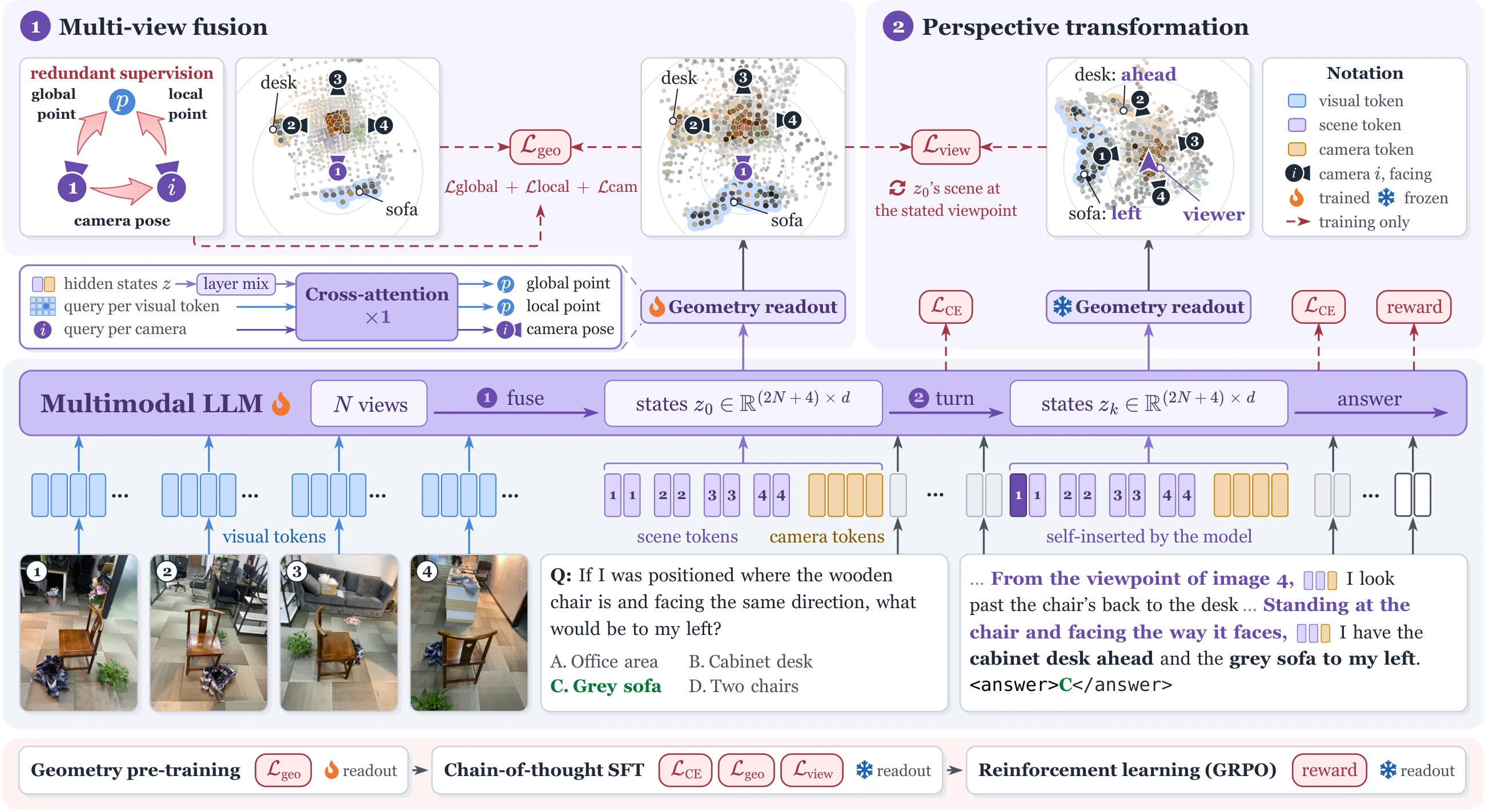
Inside the model: one scene, turned with the reasoning
We freeze each model and fit light probes on its hidden states, so whatever they recover was computed by the model itself. Fine-tuned baselines encode each view on its own, but they neither fuse the views into one scene nor follow the reasoning to a new viewpoint. S-Mind does both. Hover or tap a model to single it out.
The views are fused into one scene
S-Mind recovers 65.11% of the fused points, against at most 16.02% for the baselines, and still 50.52% with eight images.
The scene turns with the reasoning
At each viewpoint the reasoning declares, S-Mind reaches 82.17%, against 25.22–37.28% for the baselines.
Show the values
S-Mind is shown after SFT on Qwen3.5-4B; the baselines are Qwen3.5-4B before and after fine-tuning and the released 3DThinker and GPD. Each probe is refit on every model's frozen backbone.
Accuracy on four spatial benchmarks
S-Mind lifts its Qwen3.5 backbones by about twenty points at both scales and rivals frontier general models. Our runs and the reproduced baselines are non-thinking, greedy, with strict answer extraction; general models are evaluated through their providers' APIs.
Show the full table
BibTeX
@article{fu2026smind,
title = {{S-Mind}: Internalizing Multi-View Geometry for Spatial Intelligence},
author = {Fu, Muxin and Yu, Peike and Zhang, Guibin and Zhou, Wenrui and
Liu, Runze and Feng, Lang and Yang, Fuchao and Chen, Feng and
Li, Yixuan and Zhang, Mengao and Zhang, Shiying and Shen, Wen and
Pan, Ling and Yan, Shuicheng and An, Bo},
journal = {arXiv preprint arXiv:2611.28649},
year = {2026}
}